
Could We Keep Dairy Cows Producing Milk Without Repeated Pregnancies?
Updated: Aug 22
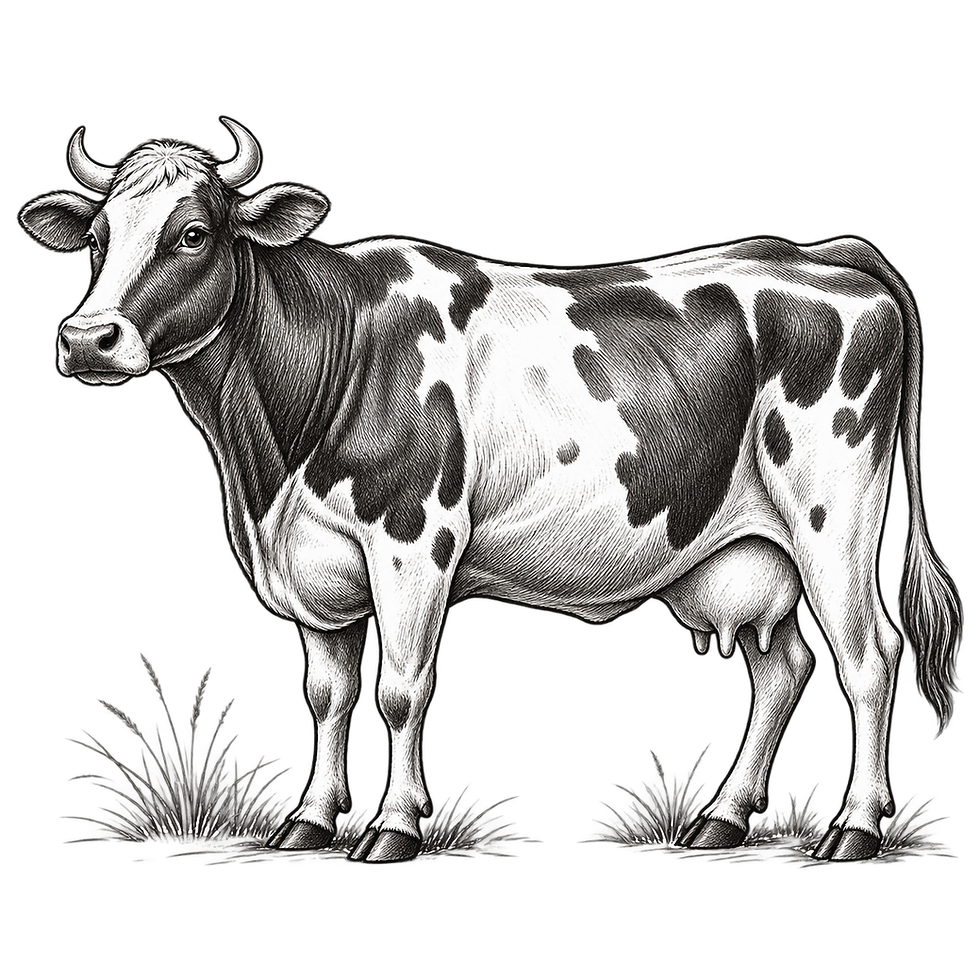
What happens when an apparently obvious animal-welfare idea collides with mammary biology, dairy economics and the inconvenient discovery that scientists have already tried half of it?
The basic fact behind dairy farming is familiar enough. A cow has a calf, begins producing milk, is milked for much of the following year and is normally made pregnant again so that, after a dry period, she calves and starts another lactation.
Which prompted what seemed to me an obvious question. "Why does she need to keep having calves?"
If hormones tell the mammary gland to start producing milk, why not have a cow go through one normal pregnancy, let that properly develop the udder and establish her first lactation, and then simply keep the milk going for much longer?
And if production eventually falls too far, could we not recreate the appropriate hormonal signals and start another lactation without creating another calf at all?
My initial mental model was essentially: cow + correct hormones = milk; calf now optional.
The Question
The conventional dairy cycle isn't quite “cow gives birth, milk abruptly stops unless another calf appears”.
A typical management system instead has overlapping processes. After calving, milk production rises rapidly, peaks and then gradually declines. The cow is normally inseminated again while she is still lactating. Eventually she is “dried off” when milking stops which is traditionally for roughly six to eight weeks before the next calving. A new lactation cycle then begins. This means the familiar 305 day lactation followed by a dry period is therefore a management cycle, not an absolute biological expiry date stamped on the udder. Researchers have been deliberately experimenting with longer lactations for decades.
That changes the question for me to how can we make each lactation last substantially longer?
How Lactation Actually Works
My first mistake was imagining one convenient “milk hormone”. Biology, predictably, has declined to provide one.
A cow's mammary gland changes dramatically during pregnancy. Oestrogen and progesterone are heavily involved in mammary development, helping produce the ducts and milk-secreting structures that will be required after birth. Other hormones and signalling systems, including prolactin, growth hormone, insulin, cortisol and insulin-like growth factors, participate at different stages.
One particularly important change occurs around calving when progesterone remains high during pregnancy and actually helps prevent full milk secretion from switching on too early. Around parturition, progesterone falls sharply. Alongside changes in prolactin, glucocorticoids and other endocrine signals, that allows the mammary tissue to enter full secretory mode.
Then there is oxytocin which is crucial, but mainly because it causes milk ejection. Stimulation of the udder causes oxytocin release, contracting specialised cells around the milk-containing alveoli and moving the milk towards the teat. It is less “factory manager orders more milk” and more “open the warehouse doors”.
Regular milk removal itself also matters. Increasing milking frequency has been shown experimentally to improve lactation persistency. In other words, there is a local demand component as well as the hormonal machinery: an udder that is repeatedly emptied receives different biological signals from one in which milk is allowed to accumulate.
So pregnancy does several jobs at once. It develops mammary tissue, creates the hormonal sequence leading towards lactation and ultimately produces the dramatic endocrine transition associated with calving.
The Interesting Bit: This Is Apparently Possible
This is the point at which I discovered that dairy scientists had, inconveniently, already thought of a substantial portion of my brilliant idea.
Cows can lactate for much longer than 305 days
“Extended lactation” is a genuine field of dairy research. Instead of breeding a cow again relatively quickly after calving, researchers postpone insemination and deliberately allow the existing lactation to continue.
One pasture-based experiment followed Holstein-Friesian cows through a planned two-year calving interval. Of 56 cows, 93% were still being milked at 500 days after calving, and some continued to around 650 days. The authors concluded that productive lactations approaching two years were biologically possible, although performance varied substantially by genotype and feeding.
Other work has followed high-yielding cows out towards 600 days in milk. A large field study found that delaying breeding increased lactation persistency and, under some extended strategies, did not produce an obvious deterioration in measured udder-health outcomes. The longest-delay group did, however, have more cows culled for poor production and tended to finish lactation carrying more body condition which is an early clue that simply saying “milk them for longer” isn't universally optimal.
A major review of extended lactation reached a similarly nuanced conclusion. First-lactation cows can be particularly good candidates; some produce as much or more milk per feeding day under extended systems, while results in older cows are less consistent. Fewer calvings also mean fewer dry periods and fewer replacement animals are required.
A 2024 review still described extended lactation as a serious potential strategy, noting fewer high-risk calving periods and potentially improved conception when breeding is eventually attempted later in lactation. Its main warning was straightforward: not every cow maintains milk production well enough, and low late-lactation production can lead to animals becoming over-conditioned.
So the first half of the idea survives: A cow does not biologically need to calve every year in order to remain in milk.
Pregnancy-free lactation can actually be induced
Researchers have experimentally induced lactation in non-pregnant dairy cows using hormonal treatments designed to imitate important parts of the endocrine environment associated with pregnancy and calving.
Experiments using combinations involving oestrogen and progesterone go back decades. Results varied enormously: some animals responded poorly, while others produced surprisingly substantial lactations.
A particularly interesting 2004 study treated 28 healthy, previously calved, non-pregnant Holstein cows to induce lactation. The induced cows subsequently averaged about 80% of their own previous natural-lactation production, although individual variation was considerable. Their average lactation lasted about 289 days. When compared with first-lactation cows in the same herd, total milk yield was lower numerically at about 7,405 kg versus 8,431 kg, but the difference was not statistically significant in that relatively small experiment.
So this isn't merely “a cow produced a few litres after somebody injected something”.
Researchers have created substantial artificial lactations in cows that were not pregnant and did not calve. However the catch is that some of the experimental systems used recombinant bovine somatotropin, or bST, to increase production. Use of BST in dairy cows is illegal in the UK, and UK rules also tightly restrict hormonal treatments in food-producing cattle, including oestradiol-17β. That makes historic experimental protocols scientifically interesting without making them a ready-made British farming method.
Could We Just Keep the First Lactation Going Forever?
Milk yield naturally declines after its peak. Part of lactation persistency comes down to how well mammary secretory cells survive and remain productive. Eventually the mammary gland benefits from a break. The dry period is therefore not simply six weeks of agricultural tradition during which everybody agrees to leave the udder alone. Instead it allows mammary tissue to remodel and supports milk production in the following lactation. Reviews of continuous milking have generally found that eliminating the dry period reduces milk production after the next calving. One meta-analysis found that omitting it reduced subsequent lactation yield substantially, although it could improve energy balance and reduce some of the metabolic strain immediately after calving.
That suggests that my original version of one pregnancy followed by ten uninterrupted years of milking is probably the wrong idea.
A more plausible DQI version would be: one genuine pregnancy → first lactation → extended lactation → dry/rest period → artificially induced lactation → extended lactation → rest → repeat. In other words, don't eliminate the lactation cycle but instead try to separate it from the reproductive cycle.
So Why Aren't We Already Doing It?
The first reason is wonderfully unromantic: milk yield. A farmer doesn't get paid for maintaining an elegant endocrine concept. A farmer gets paid for milk.
The important characteristic here is lactation persistency: how slowly milk output declines after peak production. Some cows are excellent at it. Others aren't.
If a cow reaches day 500 and is still efficiently producing a commercially useful quantity of milk, extending the lactation can make sense. If she is mostly converting feed into increasingly impressive personal upholstery, it does not. That means a blanket “breed every cow less often” policy makes much less sense than identifying suitable animals individually.
There are other complications as late-lactation milk can differ in composition. Long lactations can change the balance between milk volume, fat and protein, and poor persistency can create processing-quality issues. Feeding also has to change because a cow producing less milk no longer needs the same energy density as one near peak production.
Then there is health. Fewer calvings sound attractive because calving and the first weeks of lactation are genuine physiological pressure points. The transition around calving involves major changes in metabolism, immunity and endocrine function, and disease risk clusters around this period. Reducing how often a cow enters that transition could therefore have welfare benefits. However apparently extended lactation is not automatically a welfare upgrade as udder health still has to be managed. Mastitis does not disappear because pregnancy does. Research on altered dry periods has produced mixed results for somatic-cell counts and intramammary infection, rather than a clean “longer lactation equals healthier udder” answer.
Finally hormonal re-induction introduces another question entirely: what are the lifetime consequences of repeatedly manipulating the endocrine system in this particular way? The fact that something can initiate milk production does not establish that repeating it for years would be harmless.
Would It Actually Reduce Unnecessary Calves?
If cows calve less frequently, fewer calves are born. Extended-lactation modelling predicts exactly this: fewer calvings, fewer replacement heifers and fewer youngstock overall. A 2024 study even examined the adoption potential of extended lactation specifically as a strategy for reducing excess calf numbers.
That was my original motivation for the idea. If the primary commercial product is milk, repeatedly creating additional animals simply to reset milk production feels worth questioning, especially if biology gives us another route.
But modern British dairying has already become cleverer about what calves it produces. Sexed semen allows farmers to produce replacement dairy heifers preferentially from selected cows, while other cows can be inseminated with beef semen. According to AHDB, sexed semen accounted for 84% of dairy-semen usage across UK dairy breeds in the year to March 2025, while beef semen use in dairy herds had risen to 53%.
By 2025, AHDB reported that 60% of calf registrations to dairy dams had a beef sire, while 32% were dairy heifer calves. That means reducing dairy calvings would not simply erase thousands of unwanted dairy bull calves. It would also reduce a significant source of British beef animals. And if consumers continued eating exactly as much beef, somebody would have to produce those animals somewhere else.
That matters environmentally too. Extended lactation can reduce emissions associated with maintaining replacement heifers and other non-lactating stock. But modelling shows that part of the apparent environmental advantage can shrink and potentially reverse when the lost beef production has to be replaced by dedicated beef cattle elsewhere.
Could We Breed Cows for Longer Lactation Instead?
Rather than repeatedly forcing existing cows into a biological pattern for which they are poorly suited, could we gradually breed cows whose natural lactation curves are flatter?
In other words, don't merely select for how much milk a cow produces but instead select partly for how long she keeps producing it efficiently. Lactation persistency has a genetic component. Research has repeatedly shown sufficient heritability for selection to alter the trait, although estimates vary depending on exactly how persistency is measured.
A 2026 study describes a German Holstein breeding value specifically designed to improve production persistency in extended lactations. The breeding value itself was officially introduced in Germany in 2023. That is rather striking.
The strange idea isn't “could we invent a cow that keeps lactating for longer?”
Breeding organisations have already begun quantifying exactly that characteristic.
Perhaps the eventual system wouldn't involve elaborate repeated hormonal intervention at all.
It might involve cows genetically selected for much flatter lactation curves, bred far less frequently, with hormonal induction reserved for selected circumstances where restarting lactation without another pregnancy made biological and economic sense.
That seems considerably more plausible than my original hormonal perpetual-motion cow.
Department Verdict: SURPRISINGLY SENSIBLE (With Objections)
The original idea survives contact with reality remarkably well, provided I am allowed to change it.
“Make a cow pregnant once and then milk her continuously forever” is too simplistic.
The mammary gland changes over time. Milk production falls. Rest and tissue remodelling appear useful. Not every cow has the lactation persistency required for a radically longer production cycle.
But the underlying idea that dairy production does not inherently require a cow to produce a new calf every year or so is absolutely sound as we already know that lactations can be extended dramatically, and that non-pregnant cows can be induced hormonally into substantial lactations.
However we don't yet have a proven, regulated and economically competitive system that combines those pieces togehter.
Apparently, biology's answer to my idea is: Not entirely Outrageous.
Agricultural economics is however clearing its throat at the back of the room.
Sources & Further Reading
Sehested et al. (2019), “Review: extended lactation in dairy cattle”, Animal — a broad review covering production, reproduction, economics, welfare and environmental effects.
van Knegsel, Burgers & Edvardsson Rasmussen (2024), “Extended lactations in dairy cows and the effects on fertility and production”, Reproduction in Domestic Animals.
Kolver et al. (2007), “Extending Lactation in Pasture-Based Dairy Cows: I. Genotype and Diet Effect on Milk and Reproduction”, Journal of Dairy Science.
Magliaro et al. (2004), “Induced Lactation in Nonpregnant Cows: Profitability and Response to Bovine Somatotropin”, Journal of Dairy Science.
Kok et al. (2019), “Dry period length in dairy cows and consequences for metabolism and welfare and customised management strategies”, Animal.
van Knegsel et al. (2013), systematic review of shortened and omitted dry periods, The Veterinary Journal.
Gresham, Reiber & Chagunda (2024), “The Adoption Potential of Extended Lactation as a Strategy to Reduce Excess Calf Numbers in Dairy Farming”, Animals.
Polman et al. (2026), “Derivation of a breeding value for persistency in German dairy cattle focusing on performance in extended lactations”, Journal of Dairy Science.
AHDB data on UK use of sexed dairy and beef semen and changing calf production from dairy herds.
UK Government and Committee on Toxicity guidance concerning hormonal substances and bovine somatotropin in British cattle production.


Comments